
Showing posts with label wild food. Show all posts
Showing posts with label wild food. Show all posts
Tuesday, 27 September 2016


Tuesday, 3 December 2013
Sloe Whisky

I'm a big fan of Sloe gin, but the pursuit of different ways of using my wild gatherings is an addictive and enjoyable one. A fruit-whisky-sugar combination works fabulously well in the Scottish classic Cranachan; I see no reason why this should be any least successful. High hopes rest on getting a bit of game involved with the soon-to-be ruby mixture during the cold winter months of the new year, not to mention a cocktail or two.
40cl Whisky (it's best not to use anything to fancy/expensive, in a similar fashion to Sloe Gin making)
125g Granulated sugar
Roughly two large handfuls of Sloes
Half a cinnamon stick
A couple of cloves
Pour the sugar into a bottle with the Whisky, add the spices and then fill to the rim with sloes. Gently agitate the bottle daily for the first 7 days and weekly thereafter to help everything blend together. It'll taste good after about three months, but patience is rewarded.
Saturday, 2 November 2013
Pumpkin gnocchi with wild mushroom and chestnut butter

29th October
The willows seem to have been worse affected by the storm. Jagged splinters of wood fissure skyward along the river bank as we trudge down the hill towards the wood; the weather is brooding and unsettled. Clear blue sky and blazing sun one moment, a dark cloak of slate cloud and rain the other - we shelter under an old Oak during one particularly enthusiastic monsoon and stumble upon a large Hen of the woods mushroom nestling at the base of the trunk. Teamed with a pocketful of Sweet Chestnuts that we found earlier on in the walk, lunch appears to be gradually coming together. This is the beauty of foraging for me - the element of chance involved in any one given foray. You can use pumpkin or squash in this recipe; a sprinkle of crispy sage leaves are a worthy addition if you have them at hand.
600g Pumpkin, skin removed and cut into chunks
Fresh Thyme
Freshly ground nutmeg
Olive oil
3/4 Pint chicken stock
200g Plain flour
A handful of wild mushrooms (I used Hen of the woods, but shop-bought mushrooms work equally well)
600g Pumpkin, skin removed and cut into chunks
Fresh Thyme
Freshly ground nutmeg
Olive oil
3/4 Pint chicken stock
200g Plain flour
A handful of wild mushrooms (I used Hen of the woods, but shop-bought mushrooms work equally well)
1 Garlic clove, finely chopped
1Tbsp Chopped roast chestnuts
A large knob of Butter
1 Heat the oven to 180c/160c fan/Gas 4. Spread the pumpkin chunks out evenly in a large roasting tin. Season, add a drizzle of olive oil, teaspoon of fresh thyme leaves and a pinch of nutmeg, then roast in the oven for 30 minutes.
2 While the pumpkin is roasting, heat the stock in a saucepan. Add the roasted pumpkin to a blender, then pour over the stock. Blitz until you have a smooth, thick, soup-like mixture, then pour back into the pan.
3 Keep the pumpkin mixture on a low heat and slowly sieve in the flour, stirring continuously as you do so. It'll gradually start to thicken to a dough-like consistency. Spoon into a bowl and leave to cool.
4 There are plenty of ways of shaping gnocchi, but in this instance I found this technique to be a quick and easy way that suits the dough consistency of this recipe. Take two spoons. Use one spoon to chop off a gnocchi-sized portion of mixture in the bowl, then scoop up using the side of the bowl to form a rugby ball-shaped gnocchi as you do so (see step pic). Use to second spoon to scoop underneath the little gnocchis (gnocchlets?) and let them drop into a hot oiled pan. Fry until golden.
1Tbsp Chopped roast chestnuts
A large knob of Butter
1 Heat the oven to 180c/160c fan/Gas 4. Spread the pumpkin chunks out evenly in a large roasting tin. Season, add a drizzle of olive oil, teaspoon of fresh thyme leaves and a pinch of nutmeg, then roast in the oven for 30 minutes.
2 While the pumpkin is roasting, heat the stock in a saucepan. Add the roasted pumpkin to a blender, then pour over the stock. Blitz until you have a smooth, thick, soup-like mixture, then pour back into the pan.
3 Keep the pumpkin mixture on a low heat and slowly sieve in the flour, stirring continuously as you do so. It'll gradually start to thicken to a dough-like consistency. Spoon into a bowl and leave to cool.
4 There are plenty of ways of shaping gnocchi, but in this instance I found this technique to be a quick and easy way that suits the dough consistency of this recipe. Take two spoons. Use one spoon to chop off a gnocchi-sized portion of mixture in the bowl, then scoop up using the side of the bowl to form a rugby ball-shaped gnocchi as you do so (see step pic). Use to second spoon to scoop underneath the little gnocchis (gnocchlets?) and let them drop into a hot oiled pan. Fry until golden.
5 Melt the butter in a pan with the garlic, then soften the mushrooms in the hot butter for 5 minutes. Just before serving stir in the chopped chestnuts then spoon over the crispy gnocchi.
Tuesday, 28 May 2013
Spring foraging


Pic 1
• Wild sorrel
Pic 2
• Ramsons
• Garlic mustard (Jack-by-the-hedge)
• Wild sorrel
• Wild mint
• Vetch shoots
Monday, 22 April 2013
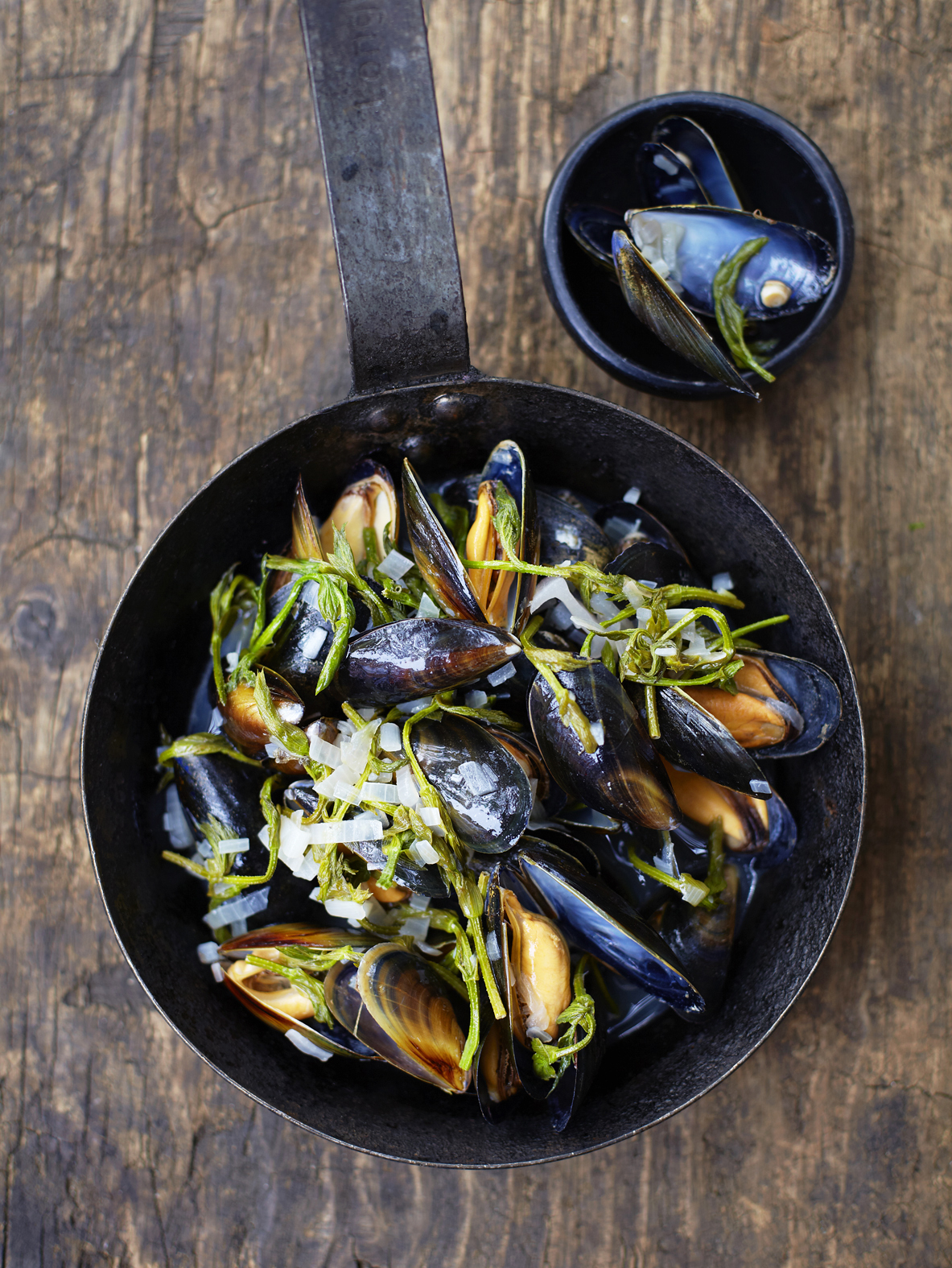
Mussels steamed in cider with hop shoots

1.5kg Fresh mussels, rinsed and de-bearded
A good handful of fresh Hop shoots
2 Banana shallots, finely chopped
A wine glass of dry cider
Olive oil
Finely chopped Ramsons to serve (optional)
In a large pan, soften the shallots in a little olive oil for about five minutes, then stir in the hop shoots for a further three. Tip in the mussels, pour over the cider and then pop the lid on the pan. Cook for about six minutes, until all of the mussels have opened. Serve with a sprinkle of finely chopped Ramsons and crusty bread.
Tuesday, 2 April 2013
Forager's cookcard #3: Sea beet

It's widely thought that all of our domesticated Beetroot varieties were originally cultivated from Sea beet. There's a familiar, beetroot note to the raw leaves, which narrow to a spear headed point in much the same way as its garden-dwelling cousin. As the name would suggest, it almost exclusively favours the coast; I've found it in abundance from the beaches of Devon to the furthest reaches of Cornwall.
Try cutting a large handful of leaves into thin ribbons, sauteing them gently with a finely chopped onion in olive oil, before stirring in cooked orzo pasta and finely chopped Ramson leaves. Serve with grated Pecorino and a good grind of black pepper.
Tuesday, 26 February 2013
Sage and thyme calves' liver with wild mushrooms and pancetta

Recipe: James Martin
Prop styling: Polly Webb-Wilson
Food styling: Jane Hornby
Thursday, 15 November 2012

Monday, 12 November 2012
A Quick Sweet Chestnut Stuffing

I've spoken before about the giant Sweet Chestnut that arcs above my fellow Commuters and I as we wait for the train each morning. A light scattering of Chestnuts nestle among the briefcases and steaming coffees on platform one; I have just enough time to hunt around in the leaves and gather the best that have fallen the previous day before hopping on the train to Metropolis. By the time Friday arrives, I have a bulging pocketful, ready to fashion into something tasty at the weekend.
A coat pocketful of Sweet Chestnuts, roasted and shelled
1 Onion
2 Garlic cloves
About 8 Sage leaves
A pinch of dried Oregano
A thick slice of stale white bread (crust if you've got it)
Olive oil
Salt and pepper
Put all of the ingredients into a blender and blitz; the wetness of the chestnuts and onion helps bind the stuffing together without the need of egg. Roast in the cavity of your Sunday Chicken, or roll into Crab apple-sized balls, place on a non-stick baking sheet and bake for 3o minutes (200C/fan 180C/gas 6) until golden.
Monday, 15 October 2012

Monday, 1 October 2012
Forager's cookcard #2: Dulse

Dulse frittata
A large handful of dulse fronds, roughly chopped
1 Onion, sliced
1 Garlic clove, grated
A small sprig of Rosemary, finely chopped
400g Cooked new potatoes, sliced
4 Eggs
Salt & pepper
Olive oil
1 Fry the potatoes in an oiled non-stick pan until they start to crisp up. Add the Dulse, onion, rosemary and garlic, then keep stirring on a low heat for a further 10 minutes.
2 Beat the eggs in a bowl. Season, then put to ones side.
3 Try to space everything out evenly in the pan, then pour in the beaten eggs. Let the frittata cook for 7-10 mins on a low heat, then pop the pan under the grill for a few minutes to cook the top.
Monday, 10 September 2012
Bramble lollies


My 3 year old loves helping to make (and consume) these lollies; I've deliberately kept some of the Blackberry coulis back here to use in the week. It's great reduced down with beef stock and drizzled over a plump Venison steak.
500g Organic Natural Yoghurt
250g Blackberries
50g Sugar
1 Gently simmer the blackberries, sugar and a splash of water in a saucepan until the fruit has broken down and the liquid is bubbling. Allow to cool for a short while, blitz in a blender and then strain through a sieve. Let the coulis cool to room temperature.
2 Gently mix about two-thirds of the coulis into the yoghurt. Don't mix it in completely, it's nice if your lollies retain a bit of pattern and swirl.
3 Pour into lolly moulds, then freeze.
Thursday, 16 August 2012

Sunday, 24 June 2012
Forager's cookcard #1: Red clover

Red clover lemonade
A large bowl of fresh Red Clover blossoms
1 Litre of Water
5Tbsp Honey
The juice of 2 large Lemons
Heat the Clover flowers in one litre of water; bring to a near-simmer and stir intermittently for about fifteen minutes (keep a lid on the saucepan between stirs). Kill the heat, then stir in the honey until it has dissolved. Leave to cool, then strain the liquid through muslin into a fresh bowl. Squeeze in the Lemon juice, then chill the Lemonade in the fridge. Serve with slices of fresh Lemon, ice and a handful of fresh Clover flowers.
Tuesday, 5 June 2012

Sunday, 6 May 2012
Morel risotto with buttery hop shoots
 The Hop shoots are going wild in my neck of the woods. Thin green tendrils snake through the hedgerows, twisting upwards towards the sky in a flourish of Spring exuberance. It took me minutes to pinch off a large bowful this morning. I quite like crunching on them raw, but they're equally tasty quickly cooked through with a little butter.
FOR THE RISOTTO
2 Large garlic gloves, finely chopped
8 Shallots, finely chopped
1 Bay leaf
A good splash of white wine
8 Large Fresh or dried Morels, chopped (if dried, keep the water that you've soaked the mushrooms in, to add to your stock)
300g Arborio risotto rice
1 - 1.5 Litres hot Chicken or vegetable stock (kept hot of the hob)
75g Hard goat's cheese, grated
25g Unsalted butter
FOR THE BUTTERY HOP SHOOTS
A large handful of Hop shoots 25g Unsalted butter
Salt and pepper
1 Melt a knob of butter in a pan and soften the garlic and shallots in a splash of olive on a low heat for 10-15 minutes, stirring regularly. Stir in the rice, bay and mushrooms, then continue stirring until the rice grains start to look transparent. Pour in the wine, leave for a few minutes, then begin to gradually add the stock. Add it slowly, a ladle at a time and only add more when the liquid has been absorbed. After about 25 minutes the risotto should look rich and creamy, and the rice should be cooked (while still retaining a bit of bite). Season to taste. Just before serving stir in 25g of the goat's cheese and a good-sized knob of butter, to add an additional sheen of glossy richness.
2 For the buttery hop shoots, simply melt 25g of butter in a pan, then flash the shoots in the heat for 3-5 minutes. Season, then spoon on top of the risotto, with an extra grating of cheese for good measure.
Tuesday, 1 May 2012
Lime leaves

Now's the time to gather young leaves from the Common lime. But be quick; as with many wild greens, their light succulence is replaced by toughness and astringency later in the season. Lime leaves have a pleasant, cooling flavour and subtle melon notes; they're great in spring salads or sandwiches. I like to use them to make little canapes; flake a thin line of smoked mackerel along the centre spine of a leaf, squeeze a few drops of lemon juice onto the fish, finish with a few Ramson flowers and then roll into cigarellos (secure with a cocktail stick if necessary).
Tuesday, 27 March 2012
Foraging in the Forest of Dean


Our guide Raoul Van Den Broucke opens the boot and checks his kit. Walking stick. Hat. Knife. Basket. Hand-held vacuum cleaner? He explains that its primary use is to gather Garlic mustard seeds once they have fallen to the ground; the dry pods are so fragile that even the the slightest of touches sends them scattering. The thought of an unassuming pair of ramblers chancing upon Raoul as he hoovers the forest floor with a vacuum cleaner keeps me amused for the rest of the day. Raoul has a mischievous twinkle in his eye and a gift for anecdote; its easy to warm to his enthusiasm for life, wild food and the natural world.
Over a pint of ale in the village pub, we examine our bounty. Wild garlic, Hop shoots, Nettles, Wild onions - more than enough with which to fashion a tasty lunch. The pub overlooks an old churchyard filled with Yew; Raoul explains that unlike the deadly poisonous needles, the berry (Aril) flesh is sweet, and edible (always spit out the seeds though). As we walk quietly around the church afterwards, sunlight glances through a stained-glass window, covering a nearby tomb with kaleidoscopic patterns of gentle colour.
Saturday, 25 February 2012

Friday, 16 December 2011

Subscribe to:
Posts (Atom)